


Tourism Secretary Christina Garcia-Frasco is facing renewed public attention after a controversy involving a magazine cover that prominently featured her image instead of Philippine destinations. The issue quickly gained reaction online and sparked debate about the use of visibility and representation in tourism promotions.
The Social Media Spark

The controversy began when advertising and production executive Max Abasolo posted online about his disappointment over a magazine cover. He referenced the massive scope of tourism materials produced nationwide, pointing out that hundreds of tourist spots were documented, yet a portrait of the tourism secretary appeared on the cover instead. Although the post was later deleted, screenshots circulated widely and fueled criticism.
Magazine at the Center

The publication involved was the first issue of Philippine Topics, an 82-page free magazine released in December 2025. Produced by YJS Advertising and Marketing Corp. and printed by B-Ticket Inc., the magazine featured Frasco on its cover alongside a banner highlighting the Philippine Pavilion at the Osaka World Expo 2025. Several inside pages focused on the Department of Tourism, the secretary, and national tourism plans.
Public Reaction Online
Online discussions largely questioned why a government official was the main visual focus instead of travel destinations. Critics argued that tourism materials should prioritize landscapes, culture, and local experiences rather than personalities, especially when public tourism promotion is involved.
Department of Tourism Response
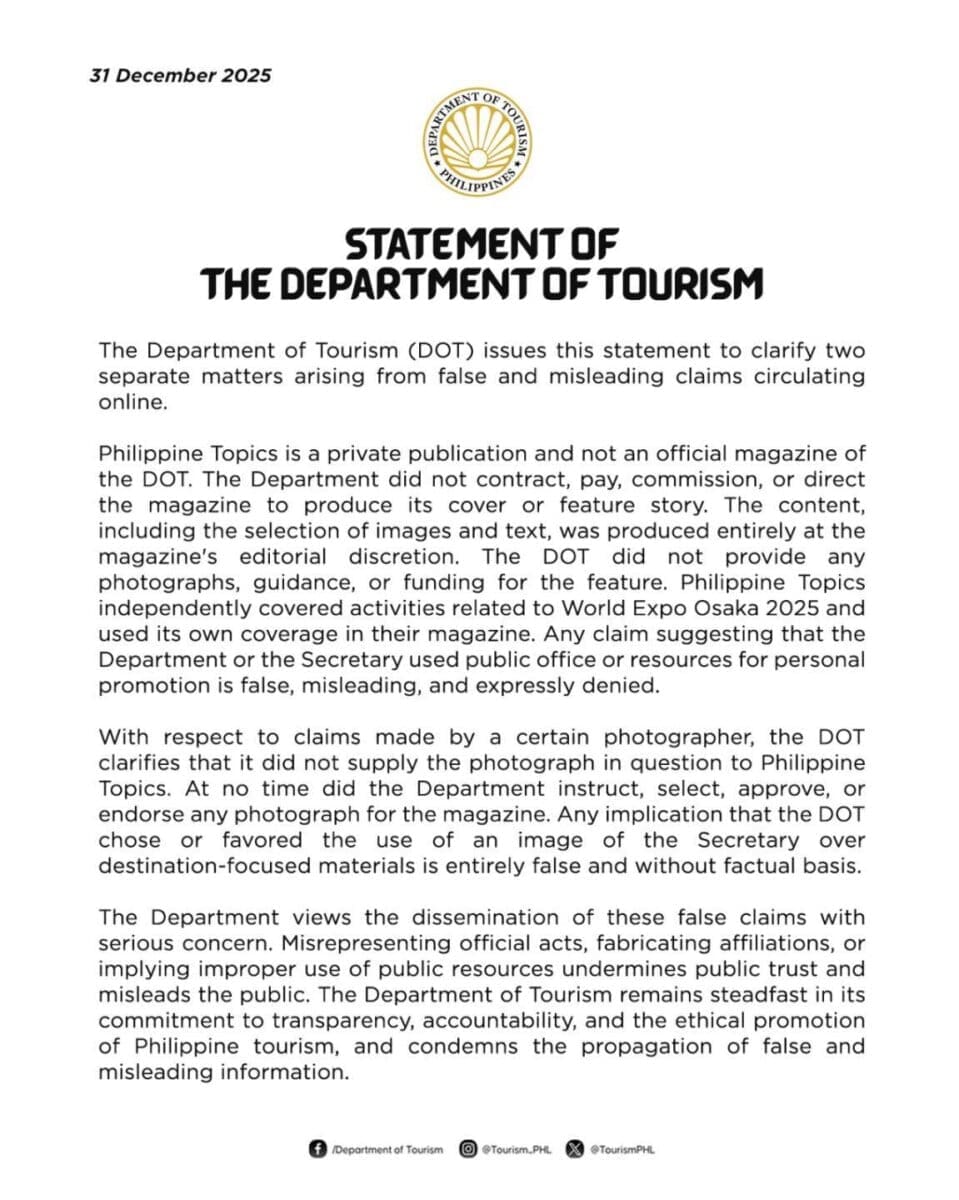
The Department of Tourism rejected claims that the magazine cover was a form of self-promotion by the secretary. The agency stated that it had no control over the magazine’s editorial decisions and did not provide or approve the photograph used on the cover. It emphasized that the publication is privately owned and independently produced.
Clarifying the Expo Coverage

According to the department, Philippine Topics independently covered activities related to the World Expo in Osaka, Japan. The DOT maintained that it neither commissioned nor paid for the magazine’s content, including the cover story, and had no role in selecting images or text.
Why the Issue Matters

The situation highlights ongoing public sensitivity around the use of images linked to public office. While the DOT denies any involvement, the incident has reopened discussions on transparency, boundaries, and how tourism promotion should visually represent the country rather than its officials.