
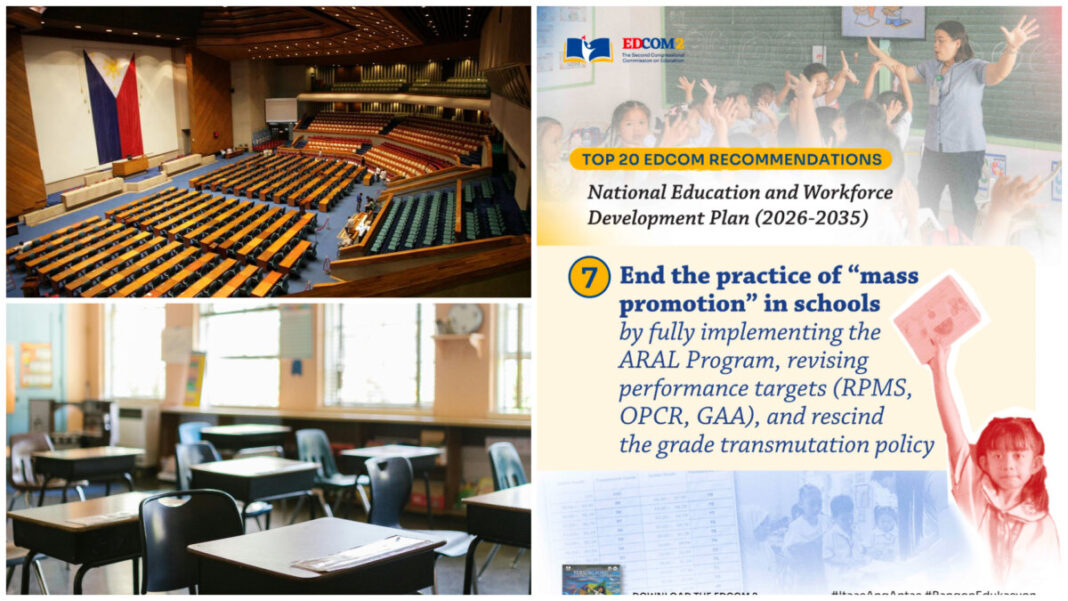
Students who struggle to read or perform basic math may soon be barred from advancing to the next grade level, as lawmakers consider stricter promotion rules under a decade-long education reform plan released this week. The proposal comes from the Second Congressional Commission on Education (EDCOM II), which is urging the government to end what it calls the country’s “de facto mass promotion” of students.

In its final report submitted to Congress on January 27, EDCOM II recommended holding back learners who fail to meet minimum literacy and numeracy standards, while also phasing out grade transmutation, a grading system that converts failing raw scores into passing marks. The commission said these practices have allowed students to move up without mastering essential skills, deepening the learning crisis in public schools.
Ending Mass Promotion
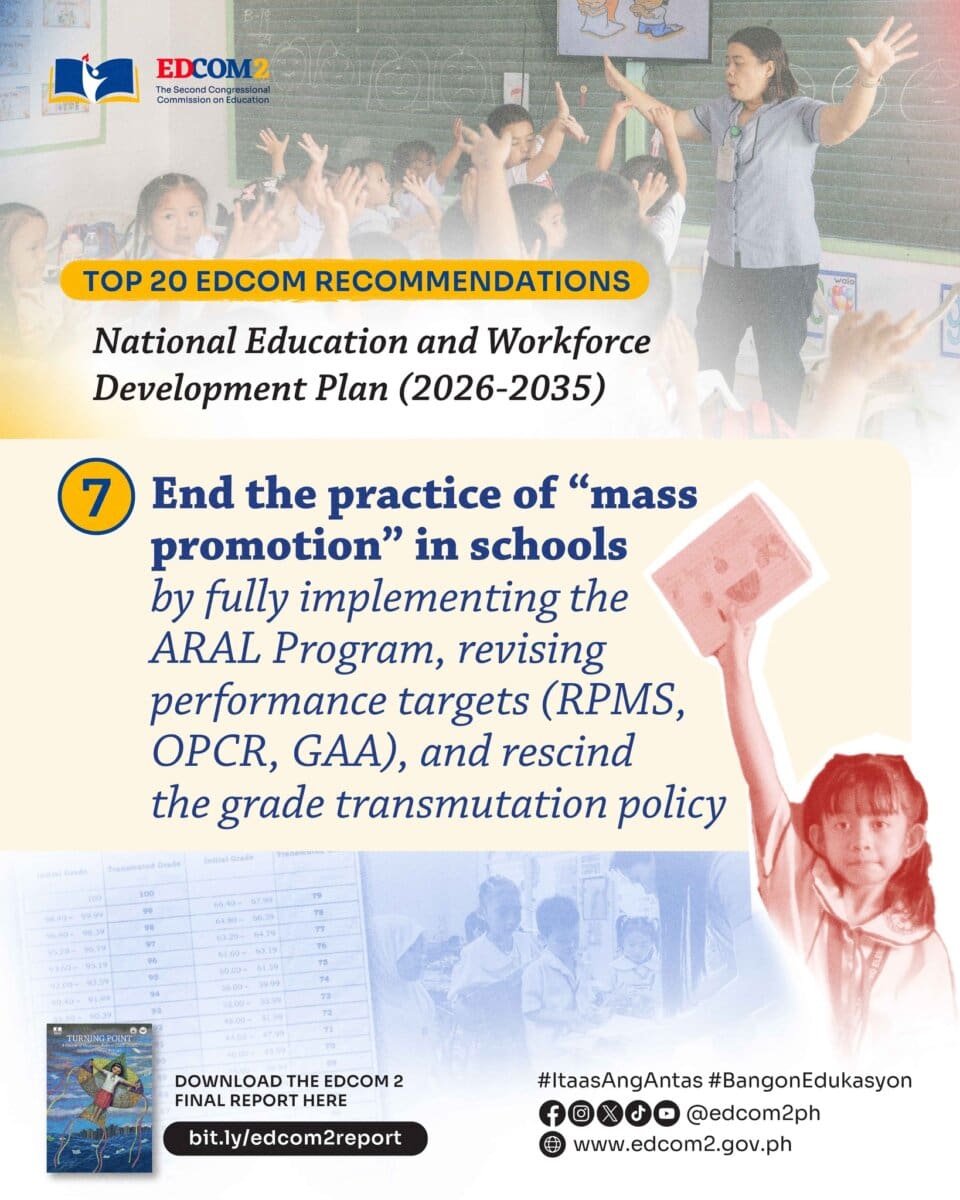
While there is no formal Department of Education (DepEd) policy that mandates automatic promotion, EDCOM II found that mass promotion has become widespread due to pressure on schools to keep failure and retention rates low. According to DepEd data cited in the report, only 30.52% of Grade 3 learners can read at grade level, dropping to 19.56% by Grade 6, and plunging to just 0.4% by Grade 12.
By Grade 7, 88% of students struggle with reading, with nearly half of junior high school learners performing at least two grade levels below expected standards. EDCOM II said these figures reflect a system that prioritizes promotion rates over actual learning, warning that students are being pushed forward without the skills needed to succeed.

Phasing Out Grade Transmutation
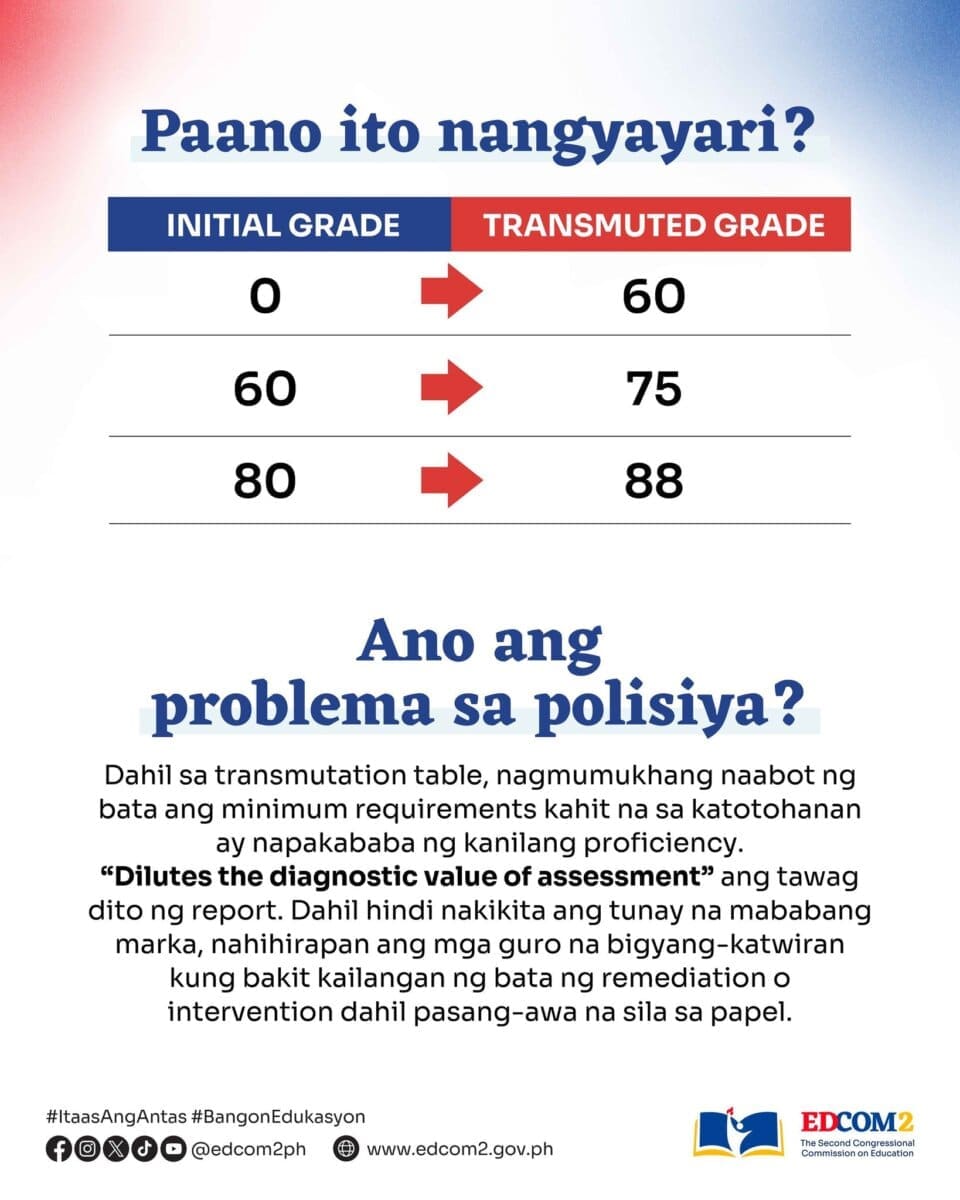
Closely linked to mass promotion is the commission’s call to roll back grade transmutation under DepEd Order No. 8, series of 2015. The policy uses a formula that can turn raw scores as low as 40% into passing grades. While meant to standardize grading, EDCOM II said it has instead masked poor performance and weakened the diagnostic value of assessments.
The commission noted that transmutation makes it harder for teachers to justify remediation, refer struggling learners to reading programs, or explain gaps in skills to parents. EDCOM II is targeting School Year 2027–2028 for the full phaseout of transmutation, recommending a shift toward criterion-based and descriptive grading focused on mastery rather than averages.

Protecting Teacher Judgment
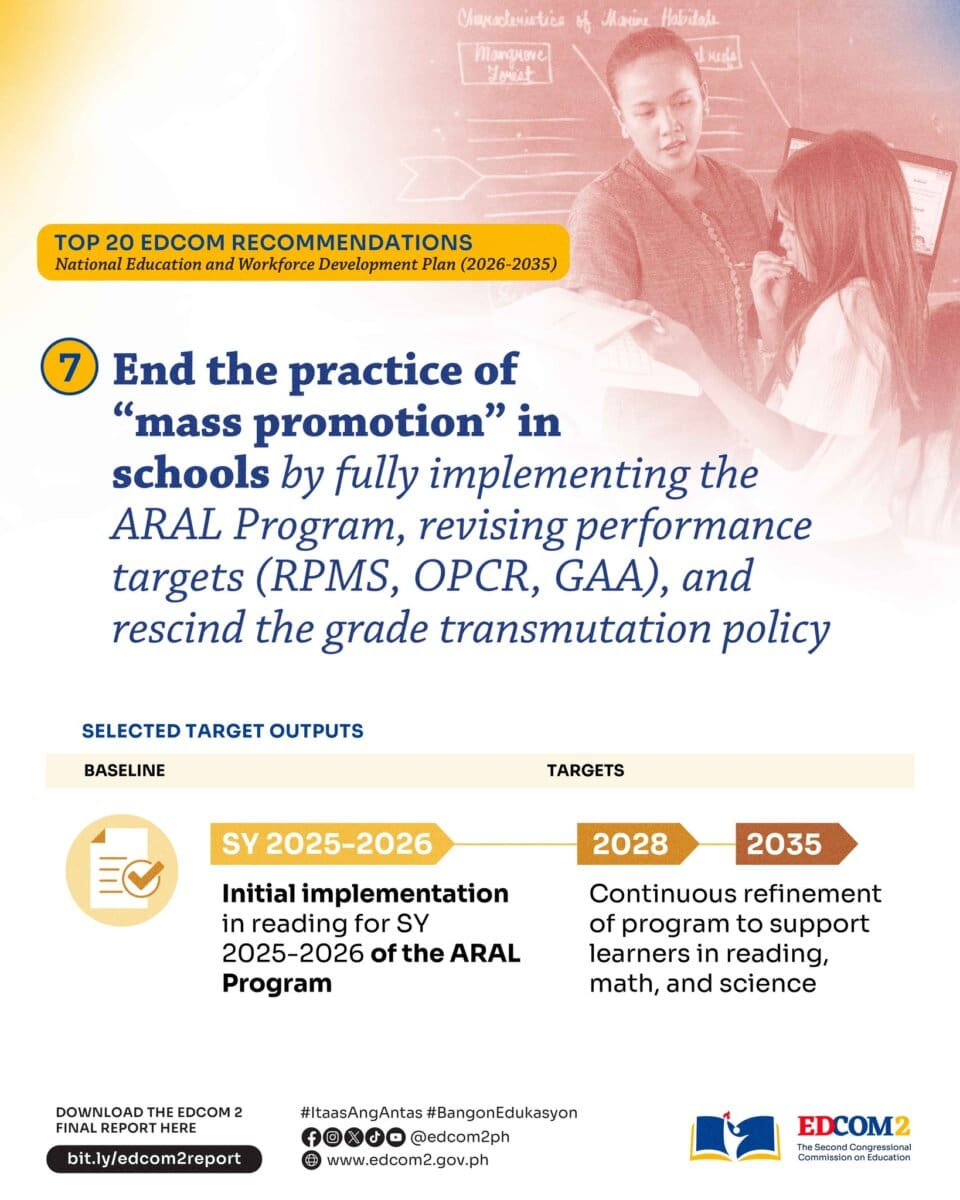
EDCOM II also called for changes to the Results-Based Performance Management System and school evaluation tools, saying current metrics indirectly encourage inflated grades. The report stressed that teachers’ professional judgment in promoting or retaining students must be protected from institutional pressure and used as a tool for learning recovery, not punishment.
Instead of penalizing schools for failed students, the commission said assessments should guide targeted funding, teacher training, and academic support programs.
Addressing Dropout Risks

The report acknowledged that mass promotion has long been used to prevent dropouts, especially among disadvantaged learners. DepEd data shows that 41.9% of students who enter Grade 1 do not finish Grade 10, often due to poverty, absenteeism, child labor, or unstable home environments.
To prevent retention from pushing students out of school, EDCOM II said stricter promotion rules must go hand in hand with strong remediation efforts. Programs like Bawat Bata Makababasa Program (BBMP) and ARAL, which provide structured tutoring and literacy support, were cited as proof that targeted interventions can help struggling learners catch up.
A Decade-Long Reform Plan
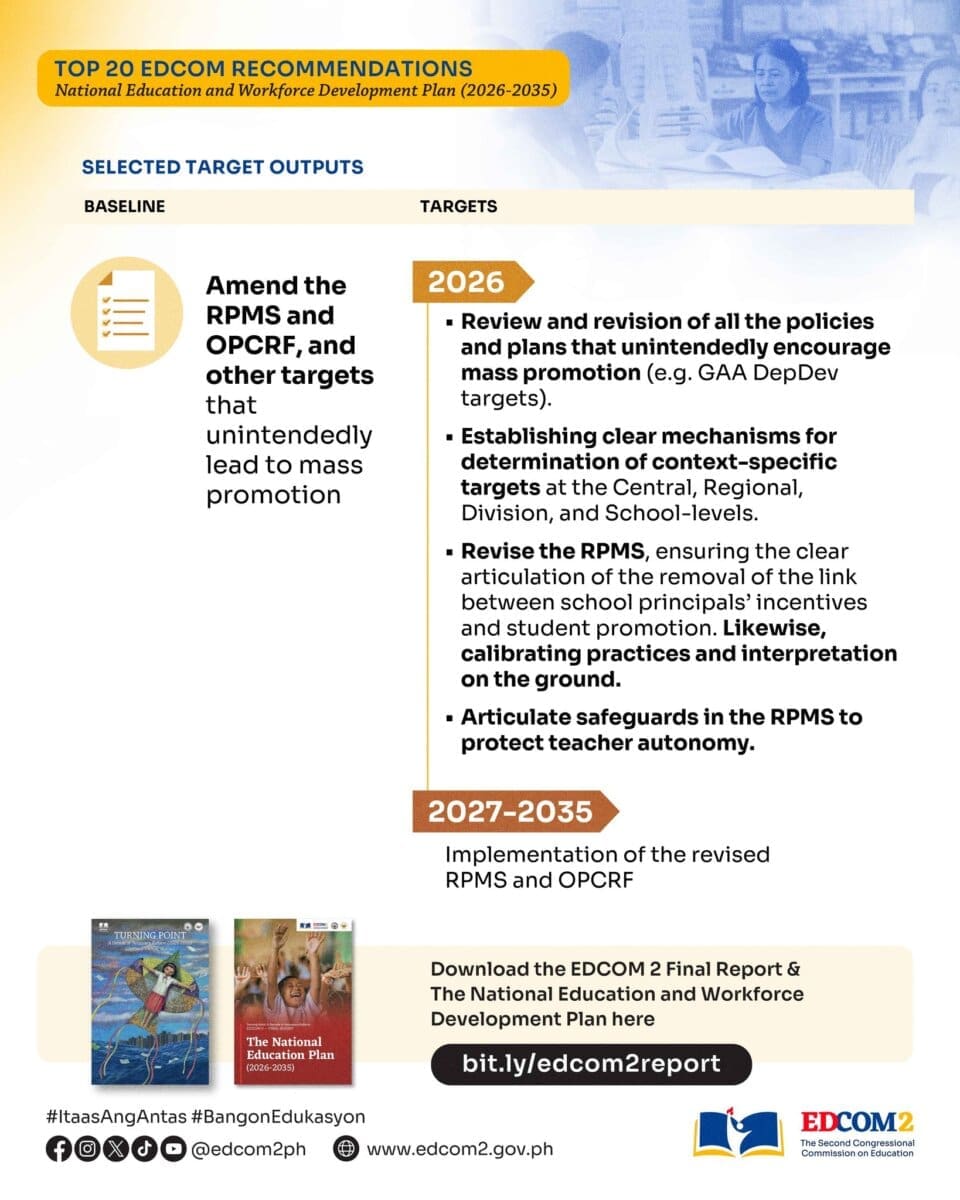
EDCOM II was created in 2022 to respond to the learning crisis exposed by the pandemic. Its 600-page report, titled “Turning Point: A Decade of Necessary Reforms,” outlines a national roadmap for education reform through 2028, 2031, and 2035, covering DepEd, CHED, and TESDA.
While the commission will only oversee initial reforms until 2027, it said clear targets and timelines were built into the plan to ensure accountability across future administrations. At the core of its recommendations is a shift away from automatic promotion, toward a system where time spent in school once again translates to real learning.